Quick Answer
Fabric GSM means grams per square meter: the mass of a fabric over a defined area. It helps a product development team communicate a target weight and compare fabric options, but it does not determine softness, thickness, opacity, warmth, durability, or quality on its own. Two knit fabrics with the same GSM can look, stretch, drape, and recover differently because their fiber composition, yarn, construction, and finishing are different. For cut-and-sew knit apparel, use GSM as one part of a material specification and confirm the selected reference in sampling before approving bulk production.
What Does GSM Actually Measure?
GSM is a measurement of fabric mass per unit area. It is not a fiber percentage, yarn count, or knit structure. A specification such as “cotton jersey, 180 GSM” gives a useful starting point, but it does not define a fabric completely. Cotton content, yarn characteristics, knit settings, finishing, and acceptable performance still need to be agreed.
For a buyer, the practical value of GSM is comparability. A measured fabric weight makes a material brief more specific than words such as “lightweight” or “substantial.” However, the measurement should be linked to an actual material reference and to an agreed method for assessment. Fabric can change after processing, relaxing, or washing; the stage at which weight is assessed matters when comparing reported values.
A supplier’s nominal weight and the measured weight of a submitted sample should not automatically be treated as identical. The team should clarify whether a quoted GSM is a target or an observed result, and what variation is acceptable for the project. That variation is a project decision, not a universal allowance.
GSM Is Not the Same as Thickness, Warmth, or Quality
Three common assumptions create avoidable mistakes in knit fabric selection.
A heavier fabric is not necessarily thicker. Fabric thickness is influenced by yarn and knit geometry, surface effects, and finishing. A loftier construction may feel thicker than a more compact fabric with a similar mass per area.
A heavier fabric is not automatically warmer. The finished garment’s thermal experience involves construction, air retention, fit, layering, and use conditions. GSM alone does not describe insulation or breathability.
A higher GSM does not automatically mean better quality. A heavy fabric can be unsuitable if its drape is too rigid for the intended silhouette, if the neckband and body fabric do not work together, or if its stretch and recovery fail the approved wearing requirements. A lighter fabric can be the more suitable choice if it meets the project’s performance and handfeel criteria.
The appropriate question is therefore not “Which GSM is best?” but “What material behavior does this garment need, and which verified fabric reference provides it?”
Why Two Fabrics With the Same GSM Can Behave Differently
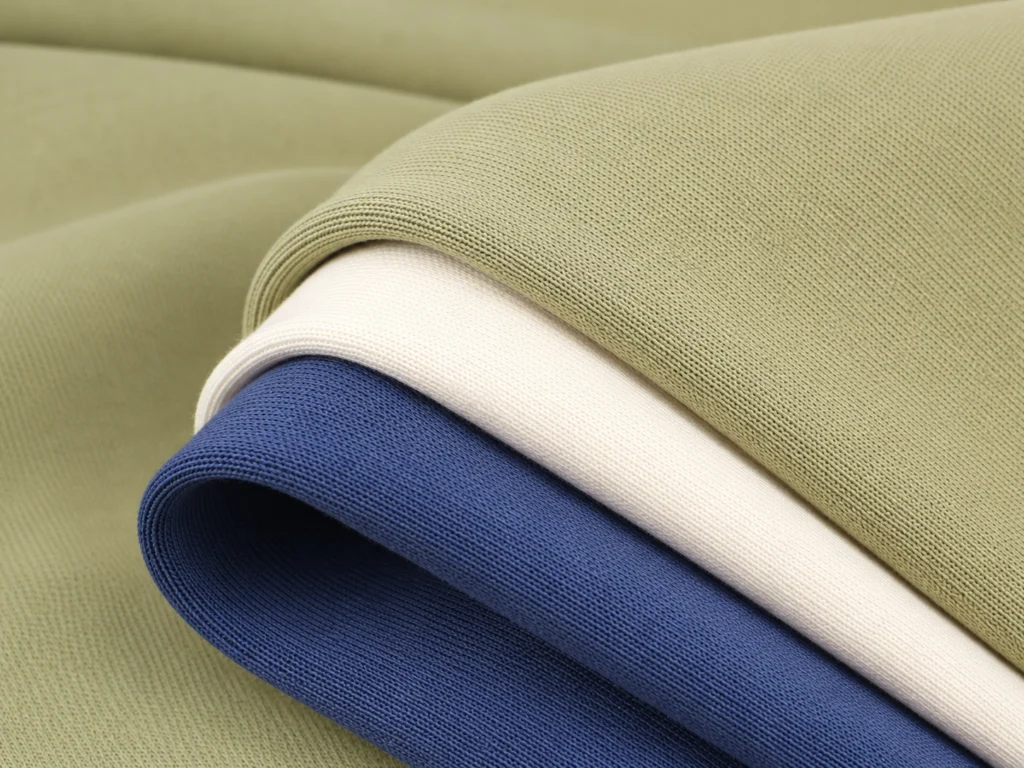
Consider two knit fabrics offered at the same nominal GSM. Even if the weight matches, their appearance and wearing behavior may be quite different.
Knit Structure
Single jersey, interlock, rib, piqué, French terry, and fleece do not share the same loop arrangement or surface behavior. Structure affects how a fabric extends, hangs, curls at cut edges, and behaves during sewing. GSM does not replace a structural description.
Fiber Composition and Yarn
Fiber blend and yarn properties affect handfeel, moisture response, deformation, and care behavior. Two fabric references should not be treated as equivalent simply because they contain the same headline fiber or carry the same weight specification.
Finishing and Fabric State
Compacting, dyeing, washing, brushing, and other finishing treatments can affect the fabric’s dimensions, surface, and apparent body. Comparison is more meaningful when the samples have been reviewed in an agreed finished state, rather than at different processing stages.
Stretch and Recovery
Stretch is how much a fabric extends under a defined condition; recovery describes how it returns after the extension is released. Neither can be reliably concluded from GSM. The intended stretch direction, garment ease, and repeated-use requirements must be considered separately.
Match Fabric Weight to Garment Requirements
GSM should be discussed alongside intended use, garment silhouette, and construction. These examples describe decision priorities rather than universal weight ranges.
| Apparel application | What to define with GSM | What must still be verified |
|---|---|---|
| Everyday knit T-shirts | Intended drape, opacity, handfeel, and silhouette | Neckline behavior, fabric recovery, wash response, and finished fit |
| Knit polo shirts | Desired body, collar compatibility, and overall appearance | Collar/placket behavior, seam stability, and surface character |
| Knit dresses | Movement, opacity, visual weight, and shape | Drape on the body, growth, recovery, and garment length after care |
| Activewear and fitted layers | Intended support, extension, and wearing comfort | Stretch direction, recovery, seam behavior, and opacity in movement |
| Hoodies and sweatshirts | Desired structure, surface, and inside finish | Bulk, handfeel, shrinkage response, and compatibility with rib trims |
| Joggers and knit pants | Desired body and drape, knee/seat behavior | Stretch and recovery, dimensional change, waistband performance |
The buyer should compare actual fabric samples against the target application. A numerical GSM range can be useful once a material direction has been established, but it should never substitute for fitting and technical review.

A Practical GSM Review Before Sampling
A material review works best when it begins with the garment rather than a list of available fabrics.
1. Describe the target garment. State whether the garment should feel soft and fluid, balanced and substantial, or structured and supportive. Add the intended fit, opacity, surface, and care expectations.
2. Identify fabric construction. Specify jersey, interlock, rib, or another relevant knit structure when known. If the structure is not yet confirmed, provide a swatch or a reference garment rather than guessing from appearance.
3. Record the proposed GSM. State whether the value is an estimate, a target, or a measurement taken from an existing reference. Record the fabric’s condition and relevant assessment method when available.
4. Review performance characteristics. Compare stretch direction, recovery, drape, opacity, surface handfeel, and washing response. Prioritize the characteristics that can materially change the finished garment.
5. Test a garment sample. Review how the material behaves after cutting, sewing, wearing, and agreed care checks. A fabric that looks acceptable as a swatch may behave differently in a neckline, hem, seam, or fitted panel.
6. Approve a reproducible reference. Link the selected material to a clear specification, sample reference, relevant test/review records, and any agreed tolerance or finishing requirement. For repeat orders, that approval becomes the comparison basis—not just an isolated GSM number.
Comparing Fabric References Without False Precision
When a team evaluates several candidates, a short decision matrix can be more useful than collecting unrelated numbers.
| Review question | Fabric A | Fabric B | Decision evidence |
|---|---|---|---|
| Is the proposed GSM suitable for the target silhouette? | To assess | To assess | Swatch plus fitted garment review |
| Does the fabric have the intended structure and surface? | To assess | To assess | Confirmed construction and visual reference |
| Are stretch and recovery appropriate? | To assess | To assess | Agreed stretch/recovery evaluation |
| Is the fabric sufficiently opaque for its use? | To assess | To assess | Review under relevant wearing conditions |
| Is care-related dimensional change acceptable? | To assess | To assess | Agreed wash/dimensional assessment |
| Can the approved result be repeated? | To assess | To assess | Documented material and production reference |
Do not fill a comparison with assumed pass/fail values. Record actual findings during product development. The buyer’s objective is an approved material direction that can be checked again when production changes or a repeat order is prepared.
When Should a GSM Change Trigger Another Sample Review?
A meaningful change in fabric weight should prompt a review of the garment’s intended performance, especially when the material substitution also changes structure, yarn, blend, or finishing. A different GSM can alter drape, opacity, seam handling, and the balance of the garment. It can also interact with trims: for example, a neckline developed with one body fabric may not retain the same appearance when the fabric reference changes.
Even when the GSM is unchanged, a different material source or construction may warrant verification. Matching one number is not the same as matching an approved fabric. Production readiness depends on confirming the relevant characteristics together.
Questions Apparel Buyers Should Ask
Before signing off on a knit fabric, ask for a clear answer to these questions:
- Is the stated GSM a nominal target or a value measured on this particular sample?
- Which knit structure, fiber blend, and finishing state does the figure describe?
- What are the priorities for drape, opacity, handfeel, stretch, and recovery?
- Which parts of the garment are most sensitive to fabric change: neckline, waistband, seams, or fitted panels?
- What sample, review records, and agreed criteria will define the approved material for bulk and repeat orders?
These questions help distinguish an attractive sample from a controlled, repeatable material decision.
FAQ
Is a higher GSM always better for knit apparel?
No. The most suitable weight depends on the garment’s use, intended silhouette, fit, comfort, and construction. A higher GSM does not independently establish fabric quality, durability, or production suitability.
Can two fabrics with the same GSM have different stretch?
Yes. Stretch depends on knit structure, fiber and yarn selection, finishing, and the conditions under which it is evaluated. GSM is a mass-per-area measurement and does not quantify extension or recovery.
Does GSM determine whether a knit fabric is opaque?
Not by itself. Opacity can vary with construction, yarn, color, fabric density, finishing, and the condition in which the garment is worn or stretched. Review a real sample under conditions relevant to the end use.
Is GSM enough to approve a fabric for bulk production?
No. Approval should connect weight with construction, composition, surface, stretch behavior, dimensional response, and a reference sample. The agreed specification and evidence should be retained for later production and reorder comparisons.
What should I send if I do not know the correct GSM yet?
Share the intended garment type, fit and silhouette, target handfeel, use conditions, preferred fabric construction if known, and any reference garment or swatch. The development brief can identify open material decisions for review before sampling.
From Weight Selection to an Approved Material Reference
A useful GSM specification is not an isolated number on a fabric card. It forms part of an agreed material reference that can be checked against the garment’s fit, construction, finishing, and later repeat production. Confirming this reference before scale-up helps make sourcing and approval decisions more consistent across orders.
For the differences between knitted structures, read Jersey vs. Interlock vs. Rib: How to Choose Knit Fabrics for Apparel. To see how material requirements are defined for development, explore Fabric Development & Material Definition. If you have a garment direction and fabric references ready for review, Share Your Project for Review.