Quick Answer
Stretch, recovery, and shrinkage are different fabric behaviors. Stretch describes extension under a defined force or condition; recovery describes the return after that force is removed; shrinkage describes dimensional change after specified care or processing. A knit fabric can stretch easily yet recover poorly, or feel stable when new but change dimensions after washing. For cut-and-sew knit apparel, buyers should define the intended garment fit, assess fabric behavior in the relevant directions, verify care response, and approve a traceable material and garment reference before bulk production.
Three Fabric Properties, Three Different Questions
The terms are often used together in sourcing conversations, but none substitutes for the others. A fabric brief that simply says “high stretch, low shrinkage” leaves too many variables undefined. The appropriate performance depends on garment construction, wearing movement, and the way the material will be washed and finished.
| Property | Question to ask | What the result does not establish |
|---|---|---|
| Stretch | How much does the material extend in the course, wale, or other specified direction under agreed conditions? | It does not automatically prove good recovery or correct garment fit. |
| Recovery | How well does the material return toward its original dimensions after extension and relaxation? | It does not automatically establish wash stability or long-term durability. |
| Dimensional change after care | How much do width, length, or relevant garment dimensions change after an agreed care procedure? | A single result does not describe every wash cycle or consumer-use condition. |
Why Knit Fabric Stretch Must Be Evaluated by Direction
Knitted loop geometry allows movement, but extension varies substantially with knit structure, yarn, elastane content, finishing, and the direction of force. A rib trim used at a neckline, for example, serves a different function from a jersey body panel. Comparing them without noting their intended use can lead to a misleading selection.
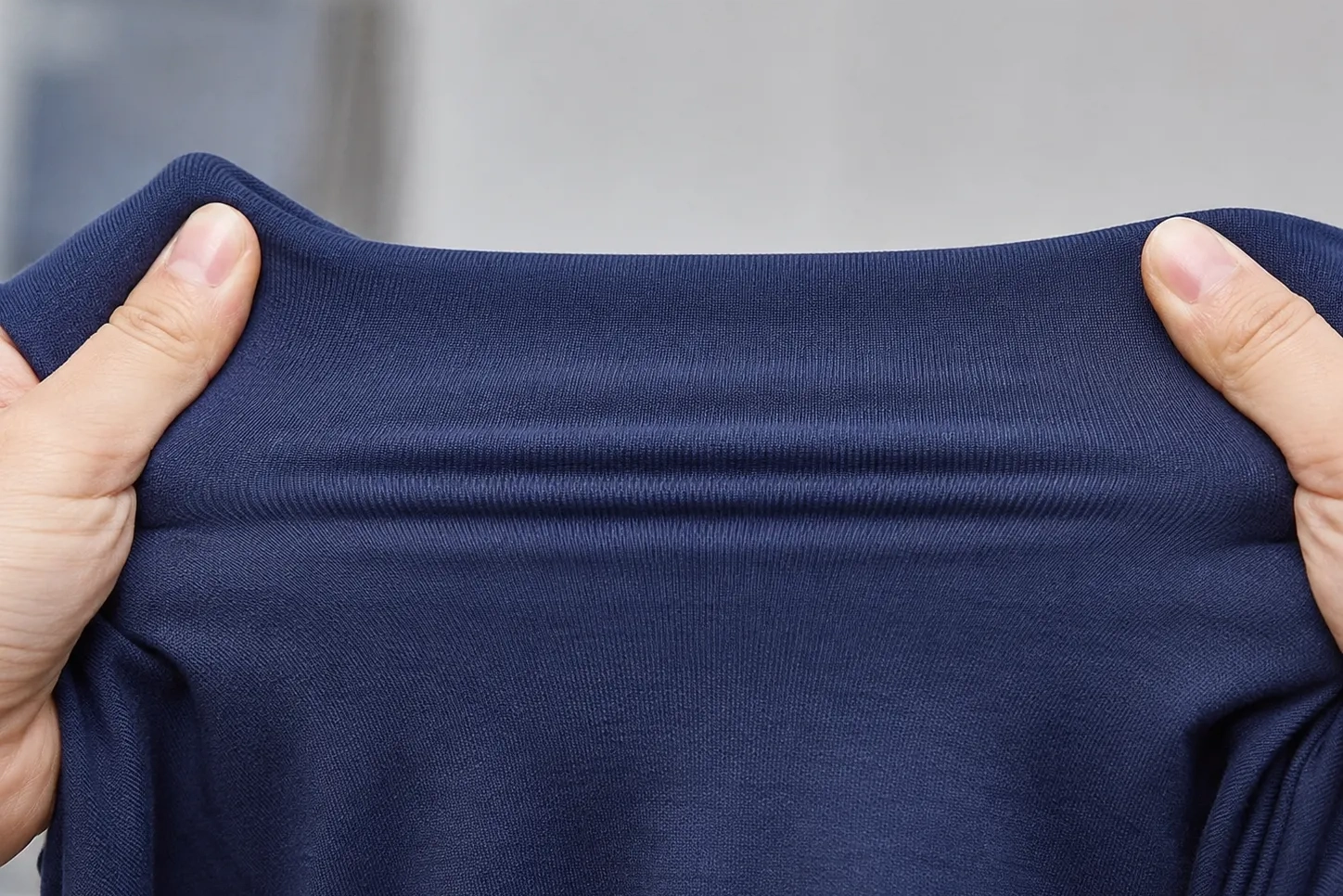
Buyers should distinguish widthwise and lengthwise stretch, and should not assume that a fabric that extends easily by hand will perform as expected after it is cut and sewn. A garment panel may encounter different loading, seam restraint, and repeated movement from a loose fabric swatch.
Stretch Percentage Needs a Defined Method
When a stretch percentage is reported, clarify the specimen dimensions, direction, applied force or loading procedure, conditioning, and calculation method. Two numbers measured under different conditions should not be treated as directly comparable. A visual hand-pull is useful for preliminary exploration but is not a laboratory result.
Recovery and Shape Retention After Extension
Recovery matters when a garment needs to maintain its intended silhouette through movement and repeated wear. A neckline that grows, a waistband that loses restraint, or a knee area that bags may be a functional problem even when the starting fabric has an attractive handfeel.
Assess recovery after a defined extension and relaxation period. Depending on the project, a buyer may also review behavior after repeated extension cycles or at the assembled garment level. Recovery is affected by fiber blend, knit geometry, elastic components, heat setting, finishing, and construction details; no single material label guarantees performance.
Buyer question: Does the material return sufficiently for this particular panel, trim, or fitted silhouette, and is the conclusion supported by an agreed review or test method?
Shrinkage and Dimensional Change After Washing
Dimensional stability is a separate risk from stretch and recovery. After laundering or other care, a fabric may become shorter, narrower, longer, wider, or distorted. The result depends on knitting and finishing conditions, fiber characteristics, garment construction, and the care procedure used. Not every dimensional change is shrinkage in both directions.
A meaningful review records baseline dimensions, specifies the wash and dry method, allows for the required conditioning or relaxation, and then measures the same reference points. Fabric-level results help screening; garment-level assessment is also important because trims, seams, panels, and printing or decoration can change the final behavior.
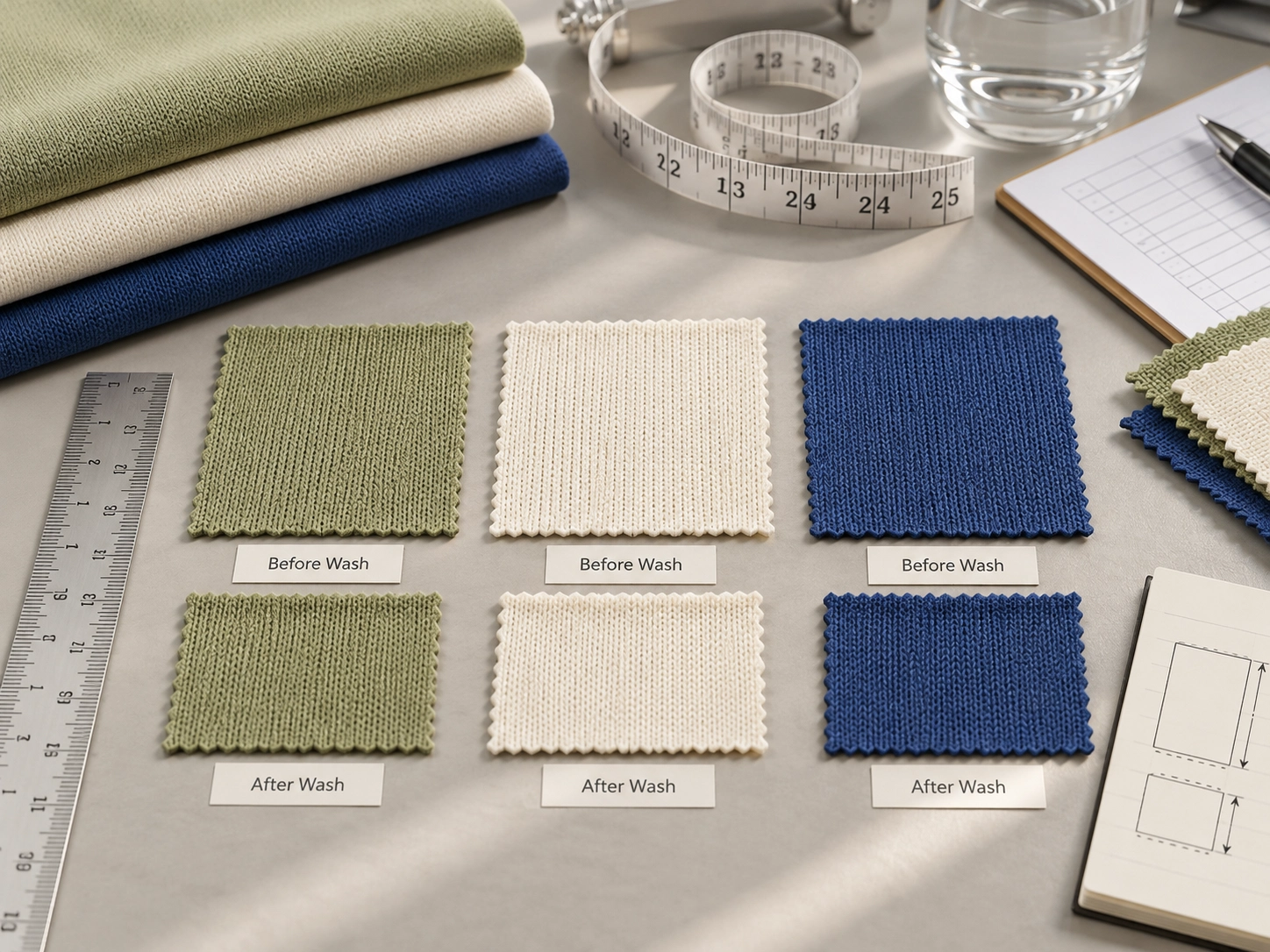
Illustrative layout only: the before-and-after fabric samples in this image do not represent measured KM shrinkage data. Any acceptance decision requires actual recorded dimensions and agreed test conditions.
Dimensional Change Is Calculated, Not Guessed
A commonly used expression for dimensional change is (after-care dimension − before-care dimension) / before-care dimension × 100%. A negative value indicates contraction under this sign convention; a positive value indicates growth. The procedure and reporting convention should be documented so results are not misinterpreted.
An agreed tolerance must be established for each material or garment program where relevant. There is no universal acceptable shrinkage figure that works for every fabric, silhouette, market, and care method.
Match Performance Priorities to Knit Garment Applications
The right combination of extension, recovery, and dimensional stability is determined by the intended product—not by selecting the highest number in a laboratory table.
| Application | Primary review priorities | Typical risk to check |
|---|---|---|
| Knit T-shirts and polos | Body and neck trim compatibility, shape retention, wash dimensions | Twisted seams, neckline distortion, unexpected length change |
| Leggings and fitted activewear | Directional stretch, recovery, coverage and seam behavior | Bagging, movement restriction, distortion in use |
| Sweatshirts and hoodies | Body-to-rib compatibility, wash response and finished measurements | Differential shrinkage, cuff or hem imbalance |
| Knit dresses | Drape, garment growth, recovery and length stability | Length change, loss of silhouette |
| Joggers and knit pants | Knee/seat recovery, waistband function and laundering stability | Bagging, waistband growth, unequal panel change |
What to Verify Before Approving Production
A pre-production review should convert sample impressions into a shared decision basis. It is not enough to write “stretch approved” without identifying which swatch, garment, method, and requirement were reviewed.
Material identity: record composition, knit structure, fabric weight, finishing state, color and reference sample. Performance: identify the required stretch directions, recovery method, care procedure and reporting units. Garment integration: review fit, seams, neckbands, waistbands, hems, and any relevant decoration. Decision control: record deviations, responsible reviewers, approval dates, and the version accepted for production.
<
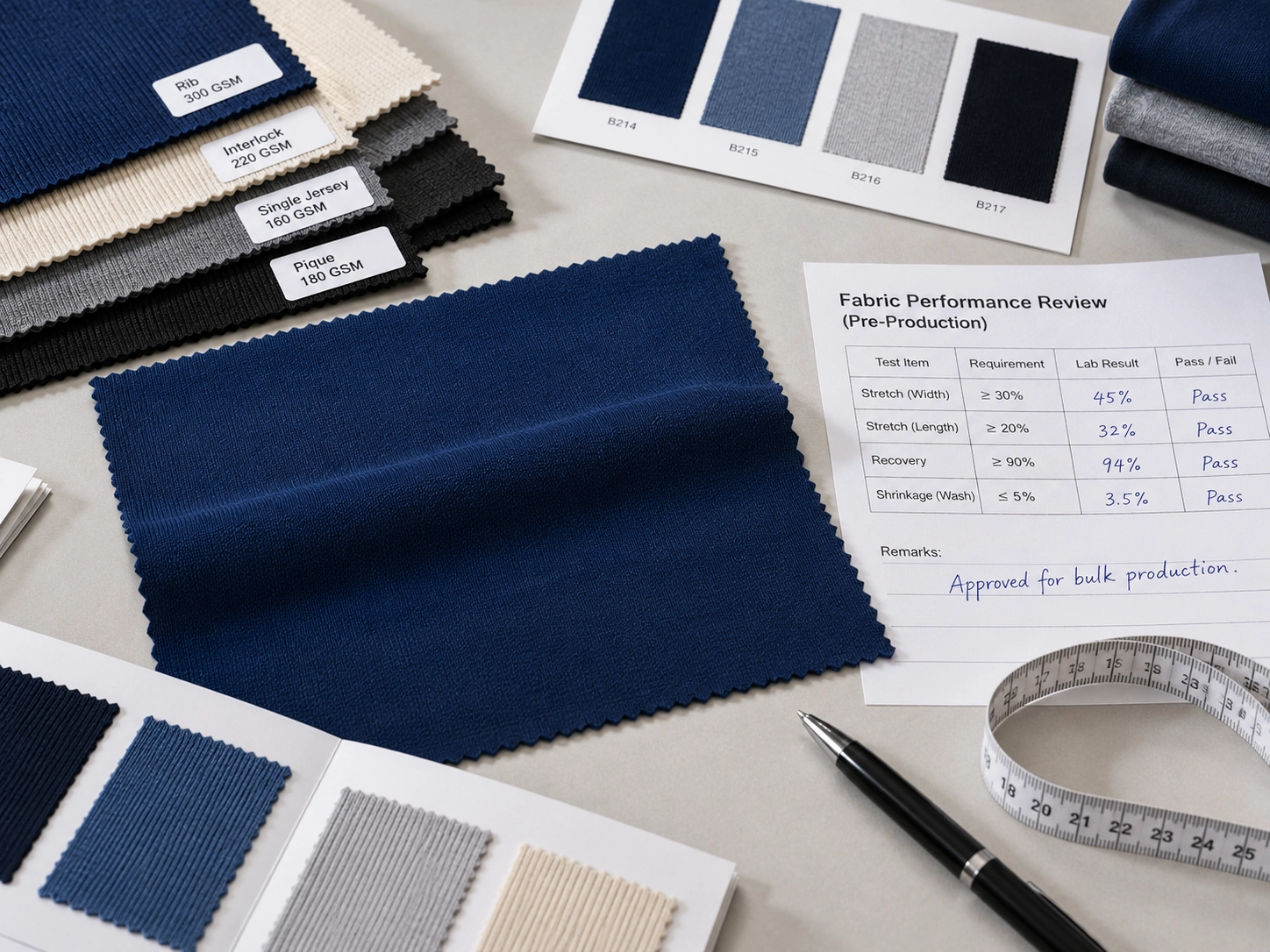
Illustrative review worksheet: values, pass marks and approval wording shown in this image are examples created for editorial illustration, not verified laboratory results or actual KnitMillsCo production approvals.
Use Consistent Testing and Review Conditions
For dimensional-change testing, standards such as ISO 5077 address determination of dimensional change in washing and drying; the selected washing and drying procedure must also be specified. For fabric elasticity or recovery, agree on a method appropriate to the material and project rather than treating percentages as interchangeable across unrelated tests. A supplier report should identify its specific method and conditions.
Turn Review Results Into a Repeatable Material Reference
Repeat orders require a link between the approved material, the garment sample, and the performance requirements. Preserve an identifiable swatch reference with its construction and finishing details, inspection criteria, and any agreed tolerances. Reorders can then be evaluated against the same decision basis instead of relying on a subjective memory of how the first sample felt.
<
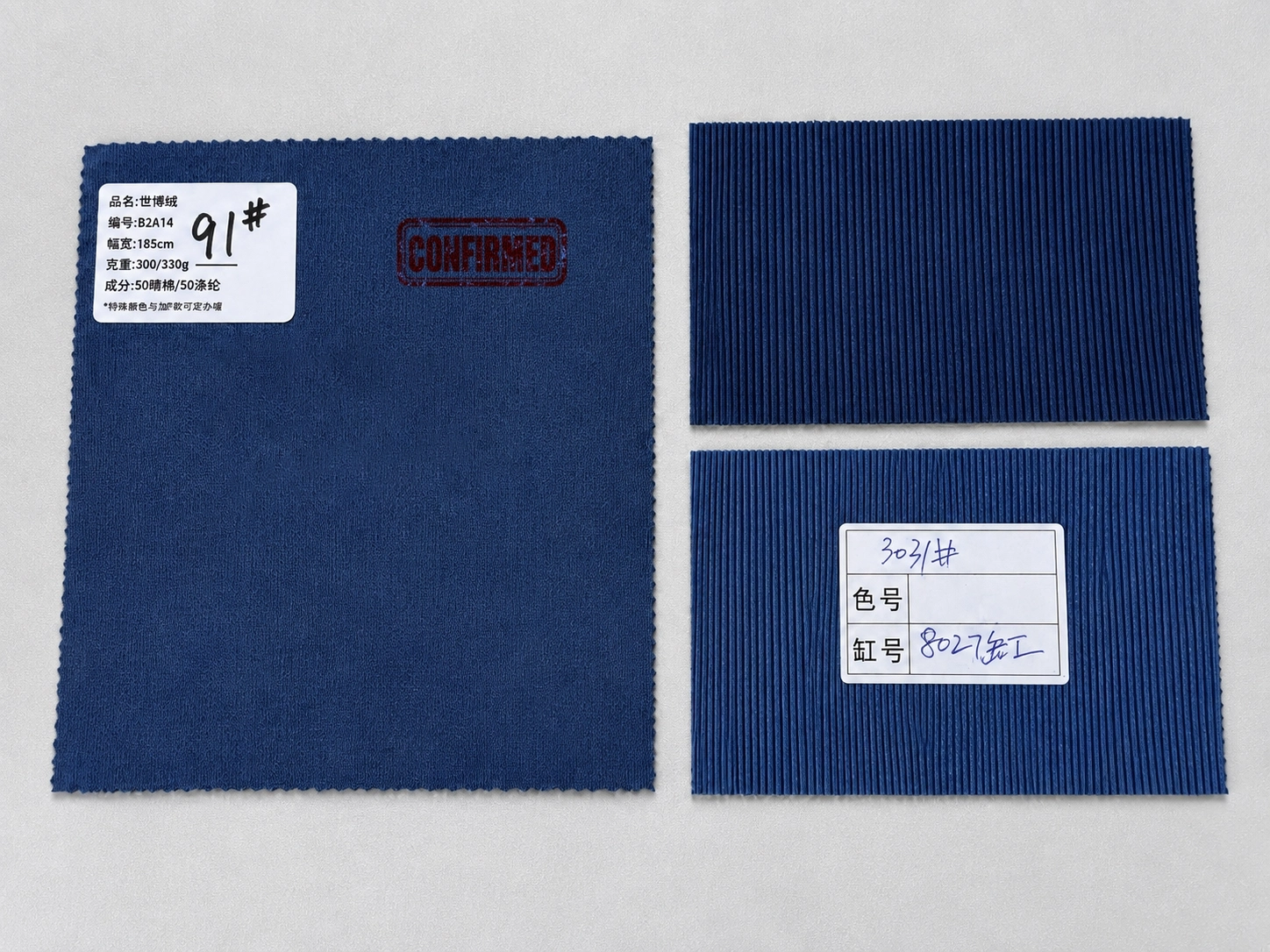
This image shows a sample-reference arrangement, not evidence that the illustrated fabrics passed particular tests or were approved by KnitMillsCo.
Where the material, dyeing, finishing, or garment construction changes, the team should assess whether additional validation is needed. Consistency is established by repeatable controls and comparisons, not by one successful sample or a blanket promise.
Questions Apparel Buyers Should Ask
Before committing to sampling or bulk production, confirm the following:
- Which directions of stretch matter for this garment, and under what conditions are they assessed?
- What recovery behavior is required for the specific body panel, trim or fitted area?
- Which wash and dry procedure applies, and how will dimensional change be measured?
- Are fabric-level observations consistent with the assembled garment sample?
- Which approved swatch, specification and review record will be used for future bulk and repeat-order checks?
FAQ
Does more stretch always mean better fabric?
No. More extension can be useful for some fitted designs, but it may be unnecessary or even undesirable for other silhouettes. Recovery, support, opacity, and garment construction still matter.
What is the difference between stretch and recovery?
Stretch describes extension under defined conditions. Recovery describes the return toward the original dimensions after extension and relaxation. They must be evaluated separately.
Can knit fabric shrink even when it contains elastane?
Yes. Elastane content alone does not guarantee dimensional stability. Fiber blend, knitting, processing, construction, and care conditions all influence the result.
Should shrinkage be checked on fabric or finished garments?
Both can be relevant. Fabric testing supports material selection, while garment assessment helps detect changes arising from seams, trims, construction, and laundering.
What should be approved before bulk production?
An identifiable material and garment reference, applicable performance requirements, appropriate test or review records, and any agreed acceptance tolerances should be aligned before release.
From Fabric Behavior to Production Readiness
If you are still choosing a structure, read Jersey vs. Interlock vs. Rib. To understand how fabric weight enters the same decision, see Fabric GSM Explained. These two material questions work alongside stretch, recovery and dimensional stability; none should be approved in isolation.
For a new cut-and-sew knit apparel project, share the intended garment application, reference sample, fabric information and expected care conditions so the open variables can be reviewed before sampling and bulk preparation.